By Callie Morgan, MBA, CFP®, CSS™, CES™
The Working Families Tax Cuts provisions of Public Law 119-21, commonly known as the One, Big, Beautiful Bill Act, were enacted on July 4, 2025, and created a new type of savings and investment account for minors: Trump Accounts. These accounts are a type of individual retirement account designed to help families begin building wealth for their children early in life. Trump Accounts offer certain tax advantages and other incentives, but before opening one, it’s important to understand how they work.
What Are Trump Accounts?
Trump Accounts are tax-advantaged investment accounts established for eligible children. They can receive contributions from several sources, including family members, employers, government entities, and charitable organizations.
Contributions made by individuals are not tax-deductible and generally create basis in the account. Certain government, charitable, and employer contributions do not create basis. During the account’s growth period, earnings grow tax-deferred. After the growth period ends, traditional IRA rules generally apply, and the tax treatment of distributions depends in part on the account’s basis.
Trump Accounts have specific eligibility, contribution, and investment requirements. Here is a breakdown of some of the key rules:
- The child must have a valid Social Security number issued before the election is made, must be under age 18 at the end of the calendar year in which the election is made, and must not have had a previous Trump Account election filed on their behalf. U.S. citizenship is not required solely to establish a Trump Account, although it is required to receive the $1,000 pilot-program contribution.
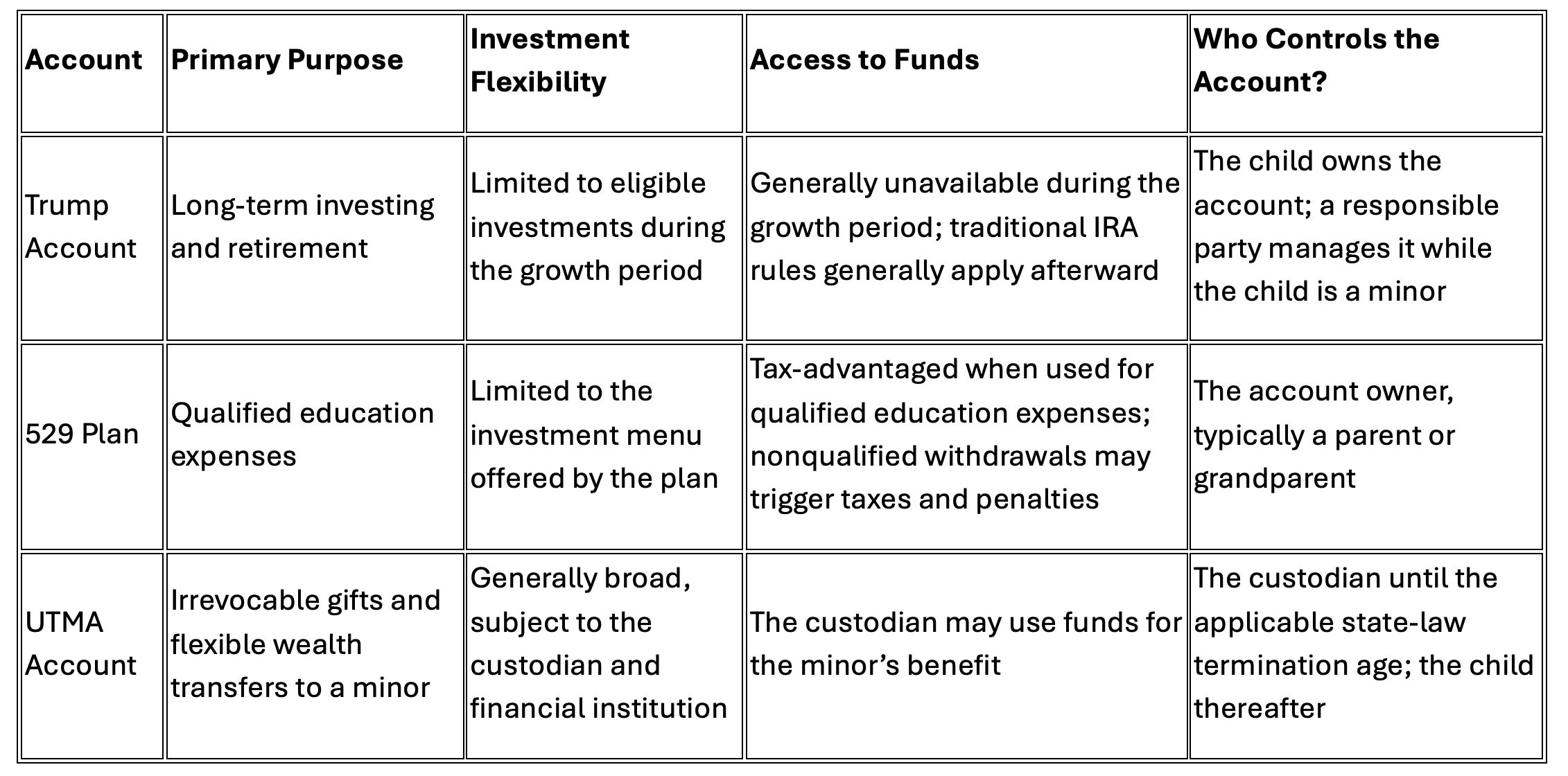
- The account is owned by the child. An authorized individual serves as the responsible party and manages the account while the child is a minor. Depending on the circumstances, the authorized individual may be a legal guardian, parent, adult sibling, or grandparent, subject to the applicable order of priority.
- During the growth period, the funds generally must be invested in eligible mutual funds or exchange-traded funds that track the S&P 500 or another index composed primarily of U.S. companies. Eligible funds must also meet requirements concerning fees, leverage, and other factors.
- The aggregate annual contribution limit is generally $5,000 during the growth period. This limit includes contributions from family members, friends, the child, and employers. The $1,000 pilot contribution, certain qualified government or charitable contributions, and qualified rollover contributions do not count toward the limit. The limit is subject to cost-of-living adjustments after 2027.
- An employer may contribute up to $2,500 per year to a Trump Account for an employee or an employee’s dependent through a qualifying employer program. Employer contributions count toward the $5,000 annual limit.
- Contributions generally cannot be withdrawn during the growth period, which ends on December 31 of the year before the child turns 18. Limited exceptions apply, including certain rollovers, distributions of excess contributions, and distributions following the beneficiary’s death.
- Beginning January 1 of the calendar year in which the child turns 18, traditional IRA distribution rules generally apply. The taxable portion of a distribution may be subject to ordinary income tax and a 10% additional tax on early distributions unless an exception applies. Exceptions may include qualified higher education expenses and certain first-home purchases.
- After the growth period, the account may remain a Trump Account subject to traditional IRA rules or may be transferred or rolled over to another eligible retirement account, subject to applicable requirements.
Parents, guardians, and certain other authorized individuals may elect to establish an account. The election can be made using IRS Form 4547 with a tax return or through the official process available at TrumpAccounts.gov.
The $1,000 Federal Contribution
The feature receiving the most attention is the federal government’s one-time $1,000 contribution. Simply opening an account does not necessarily mean the child will receive the contribution. The child must meet the pilot program’s eligibility requirements, and an authorized individual must make the appropriate election.
Only eligible children born between January 1, 2025, and December 31, 2028, may qualify for the $1,000 pilot-program contribution. The child must also be a U.S. citizen, have a valid Social Security number, and meet the program’s other requirements.
According to a March 31, 2026, IRS release, taxpayers had signed up more than 4 million children for Trump Accounts, with more than 1 million covered by elections for the $1,000 pilot-program contribution.[1]
For eligible families, this contribution may be a significant reason to consider opening a Trump Account. A $1,000 contribution invested for a child’s long-term future has the potential to compound for decades.
The Pros and Cons of Opening a Trump Account
Pros:
- The $1,000 Federal Contribution: For children who qualify, the government provides a meaningful head start without requiring the family to make the initial $1,000 contribution. An account must be established for the child, and the pilot-program contribution must be requested.
- Long-Term Compounding: Starting early gives investments more time to potentially grow.
- Encourages Investing: Trump Accounts can introduce children to the concept of long-term investing at a young age.
- Family Members Can Contribute: Parents, grandparents, and other family members may contribute, subject to the combined $5,000 annual limit.
- Potential Employer Contributions: Some employers may choose to contribute up to $2,500 per year to Trump Accounts for employees or their dependents. These contributions count toward the combined $5,000 annual limit.
- Simple Investment Structure: During the growth period, eligible investments are generally diversified, low-cost index funds. This structure may appeal to families seeking a long-term, passive investment approach.
Cons:
- Limited Investment Flexibility: During the growth period, the account is restricted to eligible investments. Families cannot choose individual stocks, bonds, alternative investments, or mutual funds and ETFs that do not meet the program’s requirements.
- Limited Access to the Money: With limited exceptions, funds cannot be withdrawn during the growth period to pay for expenses such as private school, extracurricular activities, or a car.
- The Child Owns and Eventually Controls the Account: The account belongs to the child from the outset, although a responsible party manages it while the child is a minor. Once the child assumes control, the parents no longer determine how the assets are used.
- It May Not Be the Best Account for Every Goal: A Trump Account should not automatically replace other savings strategies. A 529 plan, custodial account, or another savings vehicle may be more appropriate depending on the family’s goals.
- Investment Risk: The money is invested in the market, so its value can rise or fall. Contributions are not guaranteed to retain their original value, and long-term growth is not assured.
- No FDIC Protection Against Market Losses: Eligible mutual fund and ETF investments are not FDIC-insured against declines in market value.
Trump Accounts Compared With Other Savings Options
Bottom Line
Trump Accounts represent a new addition to the financial-planning landscape. For eligible children, the $1,000 federal contribution can provide a meaningful start, and the ability to invest for decades gives the account long-term growth potential.
At the same time, families should understand the tradeoffs, including investment restrictions, limited access to funds, market risk, and the fact that the child owns and will eventually control the account. A Trump Account may complement other savings strategies, but it should not automatically replace them.
Before opening a Trump Account, speak with your financial planner or advisor to understand how the account may fit your family’s goals and overall financial strategy.
The information provided in this article is for general informational purposes only and should not be construed as financial advice. Before making any financial decisions, it is strongly recommended that you consult with a certified financial planner™, tax advisor, attorney, accountant, or another trusted financial professional to assess your individual circumstances.
[1] Internal Revenue Service, “4 Million Children Have Been Signed Up for Trump Accounts With 1 Million Claiming the $1,000 Pilot Program Contribution,” IR-2026-42, March 31, 2026: https://www.irs.gov/newsroom/4-million-children-have-been-signed-up-for-trump-accounts-with-1-million-claiming-the-1000-pilot-program-contribution